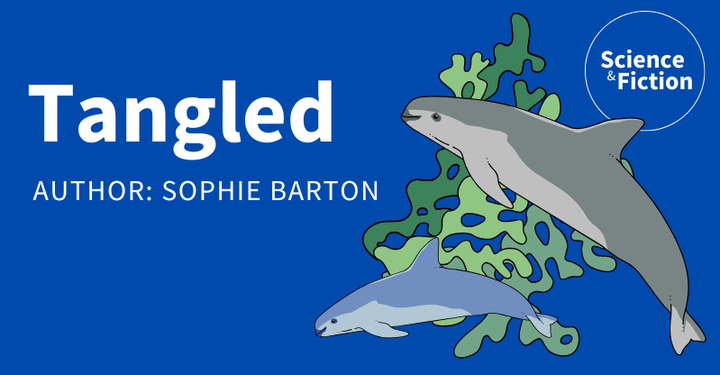
A pair of endangered porpoises struggle for survival.
Content warning
Death of a juvenile animal
The short story
Two small forms glide through the murky waters that make up the northern end of the Gulf of Mexico. The larger of the two is only four-and-a-half feet in length, a typical size for a female of her species—the vaquita, the smallest of all porpoises. Swimming by her side is her infant daughter, who is similar in size to a human toddler. Visibility is limited in this part of the gulf, so the pair stay in contact through short, high-pitched clicks.
The calf is very curious, so she often strays from her mother to investigate novel things in her environment. On this day, the hum of a nearby boat motor captures her attention. With a few rapid up-and-down strokes of her tail, she darts ahead of her mother to investigate the strange sound. As she draws closer to the boat, she can make out its dark shadow, blocking out the faint rays of sunlight from the surface.
The large, unfamiliar shape gives the young porpoise pause. It is only then that she hears the frantic clicks of her mother urging her to return to her side. The tiny vaquita produces a short series of clicks of her own to aid her mother in locating her. Within a few moments, the two vaquitas are reunited. Curving her body around her daughter, the mother nudges the calf in the opposite direction of the boat.
In the not-so-distant past, before the birth of her latest calf, the mother vaquita had also swum too close to a boat. The loud splashes of mackerel struggling in the water were what had attracted her. It was an unusual sound to be sure, but it had been a while since her last meal. She cautiously circled the boat, watching and listening for any other predators that may have also come to investigate the scene. Many species of shark were common in the area, including the infamously voracious great white.
Fortunately for the vaquita, no such creatures were present. As she drew nearer, she was able to discern the forms of many mackerel. They were moving in an unnatural, jerky way that made her uneasy. The vaquita could sense no reason why the mackerel would be so distressed—after all, there were no sharks attacking them. The situation was certainly strange, but the feeding opportunity was too great for her to abandon it. A human might have deemed the circumstances “too good to be true,” but such a concept was alien to the vaquita’s cetacean mind.
She burst forward towards the closest mackerel, clamping her conical teeth around its forked tail. But when she attempted to swallow the fish, an invisible force seemed to pull it away. With her jaws still clenched firmly around her quarry, she jerked her head abruptly to the side. It was then that she first felt a peculiar object brush against her right flipper. Frightened, she promptly released the fish and attempted to flee the scene, but the unseen attacker had wrapped itself around her flipper. She was now meeting the same fate as the fish she had intended to dine on. For a long while, she struggled valiantly against her foe, a fisherman’s gillnet, but to no avail. Her lungs yearned for air, but she was unable to surface. Eventually, she began to tire and began to flail less and less.
By some twist of fate, her lack of struggle allowed the gillnet to loosen on her flipper. The vaquita felt this reduction of pressure, and with her last ounce of strength she slowly swam forward and slipped out of the netting. She was so oxygen-deprived that she could barely find the surface, but she happened to swim upwards, and her blowhole breached the surface. After taking a deep breath, she swam as far away from the boat as possible. Little did she know that unlike so many other vaquitas, she had just survived the number one killer of her kind.
What the vaquita did know is that she, and by extension, her newborn calf, should avoid boats. If she could do this, in addition to evading more natural threats like sharks and killer whales, her daughter should grow to maturity like her other offspring in the past. Eventually, her daughter would have calves of her own, potentially helping to pull her species back from the brink of extinction.
The mother-daughter pair swims aimlessly for a while, passing by a school of impressive totoaba fish averaging six-and-a-half feet in length. Eventually, the water begins to transition from a muddy brown to a clear turquoise as they leave the center of the gulf and near the coastline. The two porpoises can now see each other more easily, so there is no reason to attract undue attention to themselves through clicking. While they are in these waters, they cease auditory communication. All kinds of harmless sea-life pass around them, including a loggerhead sea turtle who is floating near the surface to absorb warmth from the sun. For the moment, life is perfectly peaceful.
A gray animal with black lips and a black eye patch catches the mother’s eye. Another vaquita! This individual is smaller than herself, only three feet in length. The female vaquita recognizes him as a young male she has hunted with once before in a temporary pod. Such encounters are becoming increasingly rare nowadays. At twenty years of age, she still remembers a time when it would not be unusual to run into many other vaquitas daily.
The mother and calf approach the male and the two parties rub against each other in a brief greeting before carrying on their separate ways. Vaquitas are by nature solitary creatures, so they can only stand each other’s company for so long. Even still, the social encounter is exciting for the infant vaquita. Highly energized, she swims figure eights around her mother with wild abandon. Sensing no immediate danger, the mother tolerates this behavior for the moment.
Her attention shifts from her offspring to the sight of a shimmering school of silvery California corbinas, one of her favorite foods. She takes off after the fish, expecting her daughter to follow. The vaquita calf trails after her mother for a while, but now there is something interesting in her line of sight. A single fish sways up and down with the tide hypnotically. The young vaquita dashes over to it as fast as she can. She strikes the gillnet hard, and her dorsal fin, flippers, and torso have become hopelessly entangled in the netting. This is the first and last time the infant will ever feel panic and terror. It seems that the calf has not inherited her mother’s luck.
It has taken a while, but the mother vaquita has finally found the body of her drowned daughter. She is visibly distressed, and paces back and forth near the carcass, completely overwhelmed by the pain and confusion of the loss of her calf. At her advanced age, she will likely never bear another calf again. More tragic still are the repercussions her daughter’s death by an illegal gillnet will have for her species. With only ten vaquitas left in the world, the loss of a future breeding female may have guaranteed the extinction of this cetacean species. After a day of mourning, the mother vaquita abandons the little calf. She is now one of the last whispers of a once thriving species.
This story was originally written in English and without any help of AI.
The paper
Sanjurjo-Rivera, E., Mesnick, S.L., Ávila-Forcada, S., Poindexter, O., Lent, R., Felbab-Brown, V., Cisneros-Montemayor, A.M., Squires, D., Sumaila, U.R., Munro, G. and Ortiz-Rodriguez, R., (2021). An economic perspective on policies to save the vaquita: Conservation actions, wildlife trafficking, and the structure of incentives. Frontiers in Marine Science, 8, 644022. https://doi.org/10.3389/fmars.2021.644022
Connection between story and paper
The paper that inspired this story details the plight of the vaquita porpoise, which is the world’s most endangered marine mammal. When this paper was published, there were only 10 remaining individuals. The steep decline of the vaquita is primarily due to entanglement in gillnets, especially those used illegally to catch totoaba fish, which are highly valued by the Chinese black market. This paper describes how organized crime, weak governance, and poorly aligned incentives have exacerbated the plight of the vaquita. The authors propose the following solutions to make a last ditch effort to save the vaquita – strengthening fisheries management, enforcing laws better, gaining support of local communities, and investing into local economies. However, this might be too little, too late.
The author
Sophie Barton is a PhD student in the Hecht Lab of Harvard University. She studies brain-behavior evolution in dogs and Russian domesticated foxes. Sophie is also the secretary for the New Guinea Singing Dog Conservation Society. In her free time, she enjoys doing activities with her dog, like trail running and scent detection.